

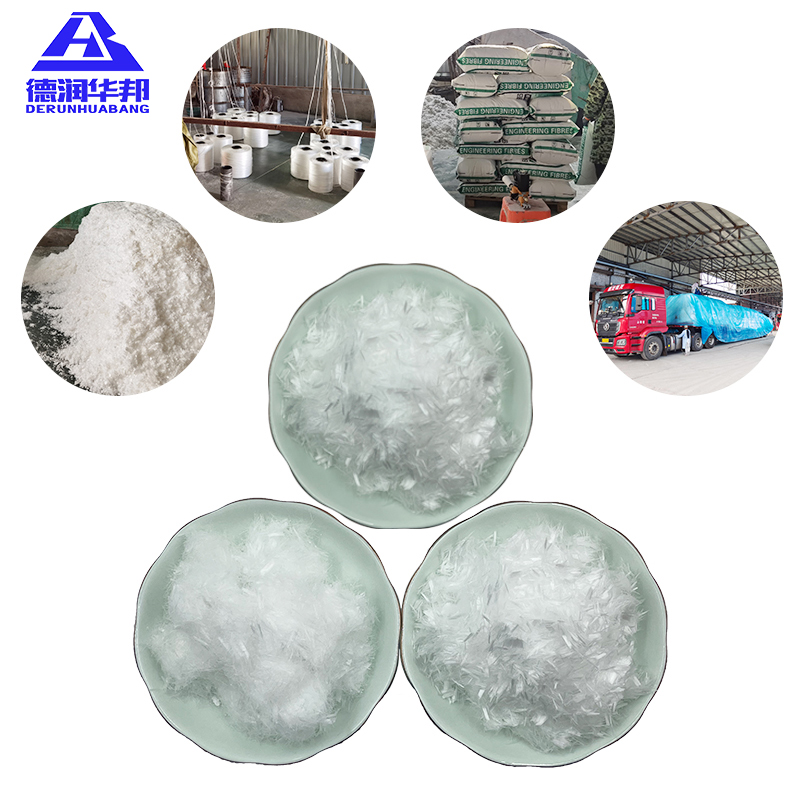
Polypropylene fiber is a synthetic fiber produced by polypropylene raw material through melt spinning, cutting and post-processing. As a common anti-cracking reinforcement material for construction engineering, it is widely used in building mortar, concrete, plastic and coating industries. It has core advantages of environmental safety, acid and alkali resistance, crack resistance and high cost performance.
1. Meticulous craftsmanship: Two production paths ensure controllable and traceable quality
(1)Natural resin processing
Processed from new polypropylene particles via melting, drawing and cutting. Stable raw material property, low comprehensive cost, suitable for ordinary mortar, pavement concrete and general filling with cost-effective demand.
(2)Modified spinning production
Adopt precise processes such as surface activation, multi-stage stretching and hydrophilic modification. Recycled polypropylene waste can be used as raw material to realize waste recycling and green production. Finished fiber has uniform length, good dispersion and strong bonding with cement, meeting high-standard projects, food contact plastic requirements.
2. Core Features: Six Major Advantages Underpin “Abundant Value”
(1)Environmentally friendly and non-toxic, compliant and worry-free
No heavy metal and harmful components, conform to EU REACH, RoHS and China national standards, non-polluting, applicable for drinking water engineering, children plastic products and indoor construction materials.
(2)Weather-resistant and lightfast, long-lasting and stable
Excellent anti-ultraviolet and anti-aging performance, no embrittlement after long-term outdoor use, stable under high temperature and rainy conditions, long-life reinforced fiber for outdoor infrastructure.
(3)Acid and alkali resistant and corrosion resistant
Outstanding alkali resistance, well compatible with cement and lime systems, stable against weak acid corrosion, the preferred anti-cracking material for anti-corrosion concrete.
(4)Strong tensile strength and excellent crack resistance
High tensile strength, forms three-dimensional network inside concrete to restrain shrinkage crack, improve impermeability and impact resistance, less addition amount can reach ideal effect and cut cost.
(5)Good dispersibility and convenient construction
Uniform fiber specification, no agglomeration when mixing with mortar and concrete, adaptable to all conventional mixing and construction techniques.
(6)Batch stability and controllable quality
Regular manufacturers implement ISO9001 quality management system, consistent fiber length and tensile index for every batch to avoid construction loss caused by unstable quality.
3. Empowering all industries: From basic building materials to high-end manufacturing, covering all sectors
(1)Building Materials Industry
Wall putty, interior and exterior wall mortar: prevent cracking and hollowing; Concrete floor, road, reservoir project: improve impermeability and wear resistance; Thermal insulation mortar: enhance structural stability and anti-cracking performance.
(2)Plastics and Rubber Industry
Plastic pipe, cable accessory, modified plastic filler: improve toughness and dimensional stability, accord with environmental standard.
(3)Industrial Coatings and Anti-corrosion Engineering
Anti-cracking functional coating, anti-corrosion mortar: increase coating toughness and extend service life of steel and concrete structures.
Post time: Jun-11-2026