product

Talc powder for automotive plastics coatings paper ceramics and rubber industrial applications enhancing material performance stability

Short Description:

Talc powder is naturally occurring mineral formed from the weathering of magnesium silicate rocks, boasting distinctive physical and chemical traits that make it indispensable in diverse industrial fields. It typically appears as fine white or gray powder with greasy texture, soft consistency and excellent lubricity—traits that stem from its platy crystal structure. Such unique characteristics enable talc powder to blend seamlessly with various materials, not just mixing well but also delivering enhanced performance and processing convenience to end products. Its inherent chemical inertness ensures stable compatibility with most substrates, avoiding unwanted reactions even in long-term use, while reliable heat resistance and electrical insulation properties further expand its application scope in high-demand manufacturing processes across different sectors.
Plastics industry relies heavily on talc powder as functional filler and reinforcement agent, especially in automotive plastic components. Talc powder integrates seamlessly into thermoplastics like polypropylene and polyethylene, effectively improving dimensional stability by minimizing warpage and reducing shrinkage during injection molding and extrusion processes. It significantly enhances heat resistance of plastic components, making them suitable for automotive parts that endure frequent mechanical stress and temperature fluctuations, such as dashboards, door panels and underhood components. Talc powder’s platy structure boosts stiffness and impact resistance of plastics without adding excessive weight, perfectly supporting lightweight strategies in vehicle manufacturing. This weight reduction helps lower fuel consumption and improve overall operational efficiency, aligning with modern automotive production trends focused on sustainability. Additionally, talc powder acts as a processing aid, reducing friction between plastic melts and mold surfaces, which shortens molding cycles and increases production efficiency for plastic manufacturers.
Coatings and paints sector benefits greatly from talc powder’s unique properties, serving as a versatile mineral filler in both industrial and architectural coatings. As mineral filler, talc powder improves paint flowability and leveling, effectively preventing sagging and dripping during application on vertical or curved surfaces. It enhances hiding power and adhesion of coatings, forming a smooth, even and durable film that adheres tightly to various substrates like metal, wood and concrete. Talc powder’s platy particles also help maintain uniform pigment dispersion, ensuring consistent color and finish across all coated products, avoiding streaks or uneven shading. Beyond aesthetics, it boosts resistance to water, acids and abrasion, extending service life of coatings used in industrial structures, machinery and outdoor equipment. Primers and intermediate coatings frequently incorporate talc powder to optimize sedimentation resistance—preventing filler particles from settling at the bottom of paint cans—and improving re-coatability, allowing subsequent layers to bond firmly, all while meeting strict quality standards of manufacturing industries.
Paper industry has long utilized talc powder for improving product quality and processing efficiency across various paper grades. Talc powder acts as both filler and coating agent, enhancing brightness, opacity and smoothness of paper—key attributes for printing and packaging papers. When used as filler, it fills gaps between cellulose fibers, creating a denser structure that strengthens paper’s ability to absorb printing inks, ensuring vivid color reproduction, sharp print quality and faster drying times. As coating agent, it forms a thin, smooth layer on paper surfaces, reducing ink penetration and improving print clarity. Talc powder also functions as essential resin control additive, absorbing residual resins and pitch in pulp to prevent machine jams, sticky rollers and surface defects like spots or streaks. In waste paper recycling processes, talc powder aids in deinking by breaking down ink particles and detackifying sticky contaminants, significantly improving pulp purity and resulting recycled paper quality. These diverse applications make talc powder a key component in producing various paper products, from high-gloss printing papers and packaging materials to tissue papers and corrugated cardboard.
Ceramics manufacturing leverages talc powder to adjust product properties and optimize processing parameters, reducing production costs while enhancing end-product performance. Adding talc powder to ceramic blanks lowers firing temperature by several degrees and widens the acceptable temperature range during firing, which not only reduces energy consumption but also minimizes the risk of product deformation or cracking. Small amounts of talc powder enhance transparency, mechanical strength and thermal stability of ceramics, making them suitable for industrial components and decorative items alike. Higher concentrations of talc powder facilitate formation of special crystals like enstatite, improving thermal shock resistance and dielectric properties—critical for ceramics used in electrical and high-temperature environments. Talc powder also serves as effective flux in glazes, reducing melting temperature, improving glaze elasticity and preventing crazing. It adds natural opacity to matte glazes, creating desired textures and finishes, while meeting both aesthetic and functional requirements of ceramic products for industrial machinery parts and construction materials like floor tiles and wall cladding.
Rubber industry uses talc powder extensively as functional filler and insulation material, enhancing both product performance and processing feasibility. It penetrates rubber matrices to enhance mechanical strength, tear resistance and internal lubrication, improving overall durability and reducing wear and tear during long-term use. This lubricating effect also simplifies processing, reducing energy consumption during mixing, calendering and molding stages. Talc powder significantly boosts electrical insulation of rubber products, making it ideal for cable insulation, rubber gaskets and other rubber components used in electrical equipment and power transmission systems. It also acts as reliable anti-sticking agent, forming a thin protective layer on rubber surfaces that prevents products from adhering to molds, machinery or each other during production, storage and transportation. Strict quality control measures ensure talc powder meets precise purity and particle size requirements for rubber applications, as inconsistent particle distribution can affect rubber’s flexibility and performance, maintaining uniformity and reliability in end product performance.
Waterproof materials production incorporates talc powder to enhance product reliability, durability and weather resistance, catering to construction and industrial waterproofing needs. It is widely added to asphalt membranes, acrylic coatings and polyurethane sealants, where it improves flexibility and elongation at break—allowing waterproof materials to adapt to structural movements without cracking. Talc powder strengthens bonding between material components, creating a seamless barrier that prevents water leakage and extends service life of waterproof systems in demanding settings like rooftops, basements, industrial tanks and bridges. Its chemical stability ensures waterproof materials maintain consistent performance under harsh environmental conditions, including extreme temperature changes, prolonged moisture exposure, UV radiation and chemical erosion. Additionally, talc powder improves rheological properties of waterproof formulations, preventing settling of heavy components and ensuring uniform application, which further enhances the effectiveness of waterproof layers.
Global demand for talc powder continues to grow, driven by expanding manufacturing sectors and technological advancements in processing. Talc powder’s versatility and cost-effectiveness make it preferred choice for manufacturers seeking to optimize product performance and production efficiency. Strict quality standards and testing procedures ensure talc powder meets industry-specific requirements, eliminating contaminants and ensuring safety in applications.


Product Detail

Product Tags

The main component of talc is magnesium silicate containing water, with the molecular formula Mg3 [Si4O10] (OH) 2. Talc belongs to the monoclinic system. The crystal is in the form of pseudo hexagonal or rhombic flakes, occasionally seen. Usually formed into dense clumps, leaf like, radial, and fibrous aggregates. Colorless transparent or white, but appearing light green, light yellow, light brown, or even light red due to the presence of a small amount of impurities; The cleavage surface shows a pearl luster. Hardness 1, specific gravity 2.7-2.8.

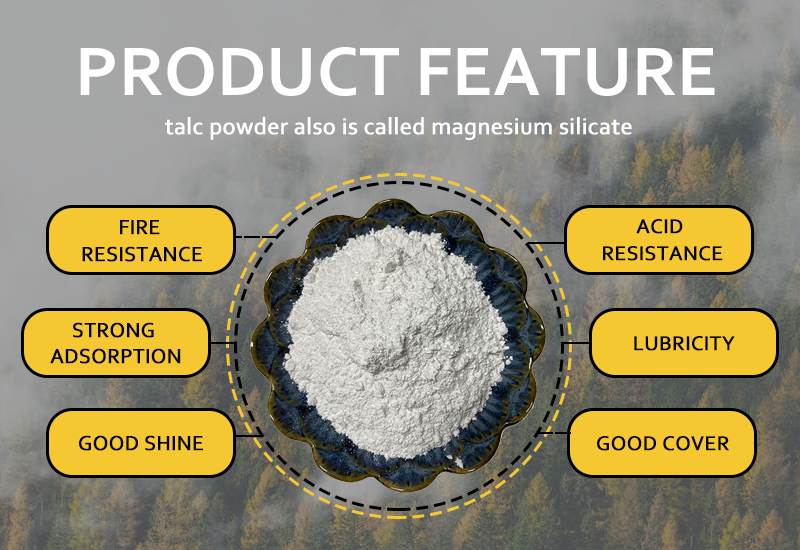
Talc has excellent physical and chemical properties such as lubricity, anti adhesion, flow aid, fire resistance, acid resistance, insulation, high melting point, inactive chemical properties, good covering power, softness, good luster, and strong adsorption. Due to its layered crystal structure, talc has a tendency to easily split into scales and special lubricity. If the content of Fe2O3 is high, it will reduce its insulation.

Talc is soft, with a Mohs hardness coefficient of 1-1.5 and a sliding sensation. The {001} cleavage is very complete, and it is easy to crack into thin slices. The natural resting angle is small (35 °~40 °), and it is extremely unstable. The surrounding rock is silicified and slippery magnesite, magnesite, lean ore, or dolomite marble. Except for a few moderately stable rocks, they are generally unstable, with developed joints and fractures. The physical and mechanical properties of the ore and surrounding rock have a significant impact on the mining process.

Chemical grade
Usage: Used as a reinforcing and modifying filler in chemical industries such as rubber, plastics, paint, etc. Features: Increase the stability of product shape, increase tensile strength, shear strength, winding strength, pressure strength, reduce deformation, elongation, thermal expansion coefficient, high whiteness, and strong particle size uniformity and dispersion.

Ceramic grade
Usage: Used for manufacturing high-frequency ceramics, wireless ceramics, various industrial ceramics, architectural ceramics, daily ceramics, and ceramic glazes. Features: High temperature non discoloration, enhanced whiteness after forging, uniform density, good luster, and smooth surface

Cosmetic grade
Purpose: It is a high-quality filling agent in the cosmetics industry. Features: Contains a large amount of silicon element. It has the function of blocking infrared rays, thereby enhancing the sunscreen and infrared resistance performance of cosmetics.

Medical and food grade
Usage: Used as an additive in the pharmaceutical and food industries. Features: It is non-toxic, odorless, with high whiteness, good compatibility, strong glossiness, soft taste, and strong smoothness. A pH value of 7-9 does not degrade the characteristics of the original product.

Paper grade
Purpose: Used for various high and low grade paper industry products. Characteristics: Paper powder has the characteristics of high whiteness, stable particle size, and low wear. The paper made with this powder can achieve smoothness, delicacy, save raw materials, and improve the service life of the resin mesh.

Brucite powder
Usage: Used for manufacturing electric porcelain, wireless electric porcelain, various industrial ceramics, architectural ceramics, daily ceramics, and ceramic glaze. Features: High temperature non discoloration, enhanced whiteness after forging, uniform density, good glossiness, and smooth surface.滑石粉_03


  • Previous:
  • Next:

  • Write your message here and send it to us