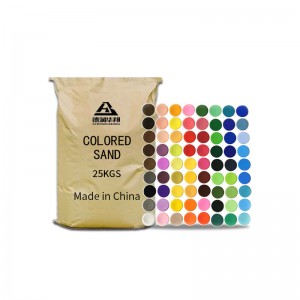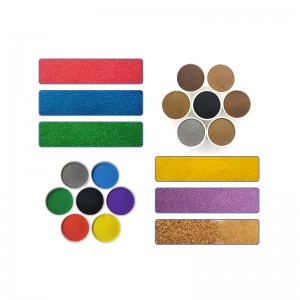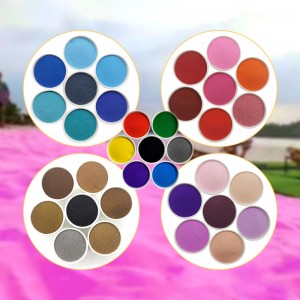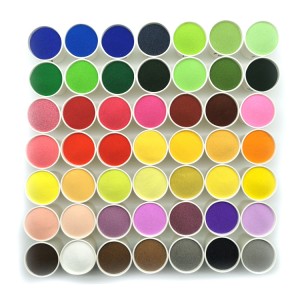


Colored sand for sustainable construction eco friendly decoration durable surface application architectural adornment landscape design enhancement industrial coating support decorative craft creation
Short Description:
Colored sand emerges as core material in global construction, decoration, and industrial fields, bridging natural mineral resources and human creative needs. Unlike ordinary sand with monotonous gray hue, colored sand gains vivid tones through natural geological processes or eco-friendly artificial pigmentation, carrying dual advantages of natural texture and stable color. Its application spans from grand architectural facades to delicate craftworks, from urban landscape projects to industrial surface treatments, forming unique industrial chain that aligns with sustainable construction and eco-friendly decoration trends. As industries pursue low-carbon transformation and consumers demand materials with both aesthetic value and durability, colored sand breaks through traditional application boundaries, integrating into urban renewal, rural revitalization, and high-end craft manufacturing scenarios, demonstrating enduring vitality and innovative potential.
Raw material foundation of colored sand determines its texture and color expression, with two main sources: natural colored sand and synthetic colored sand. Natural colored sand originates from natural mineral deposits formed through millions of years of geological evolution—quartz sand, feldspar sand, and marble sand are primary carriers, with colors derived from trace elements in minerals or weathering effects. Red colored sand from Yunnan, China, gains its hue from iron oxide trace elements in quartz sand; yellow colored sand from Arizona, USA, comes from feldspar sand containing potassium and sodium oxides; green colored sand from Norway is formed by serpentine mineral weathering, carrying unique emerald tones. Mining of natural colored sand adheres to strict ecological protection standards: in Norway’s serpentine mines, miners adopt selective digging to avoid large-scale vegetation destruction; after extraction, topsoil is preserved and reused for reforestation, with native moss and shrubs planted to restore soil stability. Synthetic colored sand, by contrast, uses high-purity natural sand (such as quartz sand with low impurity content) as base material, then undergoes surface pigmentation with eco-friendly inorganic pigments. Pigments used are mainly iron oxide, titanium dioxide, and chromium oxide—non-toxic, light-resistant, and chemically stable, ensuring colored sand retains color without releasing harmful substances. This dual raw material system not only secures diverse color supply but also adapts to different application scenarios: natural colored sand is preferred for projects pursuing earthy texture, while synthetic colored sand dominates fields requiring uniform color and high consistency.
Production process of colored sand combines natural processing and modern eco-friendly technology, ensuring product quality while minimizing environmental impact. For natural colored sand, mined mineral sand undergoes physical processing: first, crushing into coarse particles using jaw crushers, then screening to remove oversized impurities; subsequent washing with clean water removes dust and clay, preserving natural mineral luster; drying in solar-powered drying yards (instead of fossil fuel heaters) reduces energy consumption; final screening classifies particles into different sizes—fine sand (0.1-0.3mm) for coatings and crafts, medium sand (0.3-0.6mm) for landscape paving, coarse sand (0.6-1.2mm) for architectural aggregates. Synthetic colored sand production follows strict environmental procedures: base sand is first purified to remove impurities that affect pigment adhesion; then mixed with inorganic pigments and small amounts of eco-friendly binders in rotating drums, ensuring uniform pigment coating on sand surface; curing at moderate temperatures (avoiding high-temperature calcination that increases energy use) enhances color fastness; final cooling and screening ensure particle size consistency. Both production modes avoid toxic chemical additives and excessive energy consumption: natural colored sand processing uses only physical methods, while synthetic colored sand uses water-based binders and low-temperature curing, embodying eco-friendly production principles.
Core characteristics of colored sand—natural texture, color stability, durability, and compatibility—make it indispensable across diverse industries, setting it apart from ordinary decorative materials. Natural texture is most distinctive trait of colored sand: each particle retains natural mineral lines and roughness, creating unique tactile and visual effects. When used in architectural facades, colored sand forms matte or semi-matte surfaces that reflect soft light, avoiding glare caused by smooth materials; in craftworks, its granular texture adds three-dimensional sense, making works more lifelike. Color stability is another key advantage: natural colored sand’s hues come from inherent mineral components, resisting UV radiation and weathering; synthetic colored sand uses inorganic pigments with strong light resistance—colored sand used in outdoor landscapes retains original tone for over 15 years, while organic-pigmented materials might fade to pale shades within 3 years. Durability of colored sand is verified in practical applications: when mixed into concrete, it increases surface abrasion resistance by 40%, making it suitable for high-traffic areas like shopping mall floors; when used as coating additive, it enhances film hardness, preventing scratches and cracks. Compatibility is also notable—colored sand mixes seamlessly with concrete, mortar, paint, epoxy resin, and plastic, adapting to diverse processing techniques such as spraying, paving, casting, and bonding. This versatility allows colored sand to integrate into multiple industries, from construction to crafts, meeting varied functional and aesthetic needs.
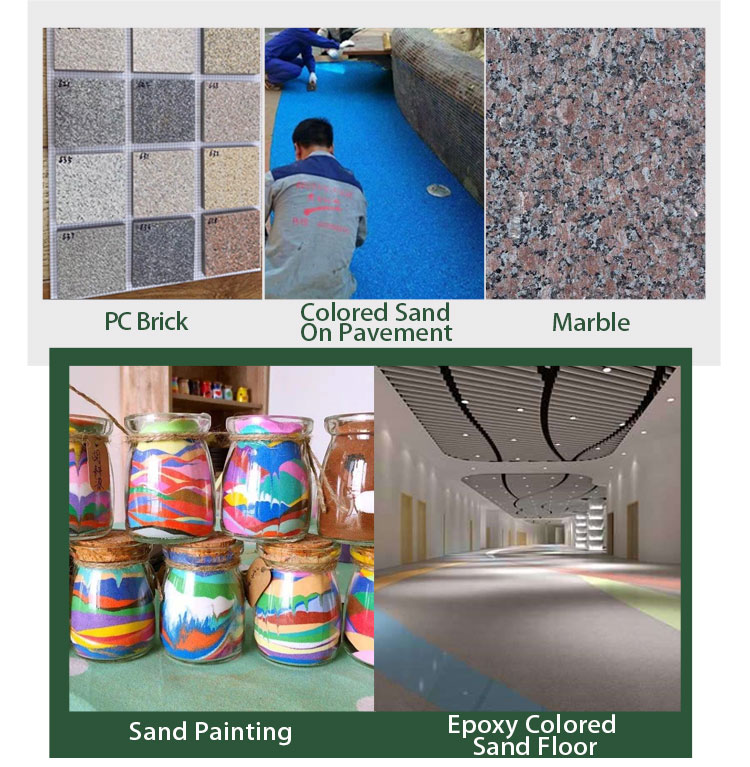
Construction industry integrates colored sand into diverse projects, from sustainable buildings to historical renovations, enhancing both functionality and aesthetics. Green building projects, a core part of sustainable construction, widely use colored sand in exterior and interior decorations. For example, low-carbon office buildings in Berlin, Germany, use red and yellow natural colored sand mixed into exterior wall mortar; the earthy hues blend with surrounding urban greenery, while sand’s thermal insulation performance reduces indoor heating demand by 30%. Historical building renovations prioritize natural colored sand to maintain architectural authenticity—restoration of ancient castles in France uses gray and brown natural colored sand to replicate original stone wall textures, with sand particle size adjusted to match historical masonry, ensuring consistency in touch and appearance. Residential construction uses colored sand in decorative elements: yellow synthetic colored sand mixed into floor tiles creates warm, comfortable living spaces; red colored sand used in kitchen backsplashes adds vivid focal points without losing natural texture. Infrastructure projects like pedestrian bridges and plazas use colored sand in paving materials: blue and green colored sand mixed into concrete paving blocks form pattern resembling riverbeds, enhancing urban landscape continuity; coarse colored sand added to anti-slip coatings on bridge surfaces improves walking safety in rainy weather. Construction engineers value that colored sand is compatible with various construction materials, including cement, lime, and gypsum, without affecting structural strength, while adding unique aesthetic value.
Landscape design industry relies on colored sand to create natural, durable outdoor spaces that blend with ecological environments. Urban parks and gardens are major application scenarios: brown natural colored sand is used in dry landscape gardens to simulate sand dunes, matching with rocks and succulents to create Zen-style spaces; blue synthetic colored sand lines artificial streams, mimicking clear water effects with its vivid hue. Children’s playgrounds use colored sand in safety surfaces and decorative elements: red and yellow fine colored sand mixed into rubber mats forms soft, non-toxic playing surfaces; colored sand-filled plastic modules spell out cartoon patterns, attracting children while ensuring safety. Residential courtyard design uses colored sand in diverse ways: white colored sand surrounds flower beds to highlight plant colors; black colored sand paves small paths, creating contrast with green lawns. Public waterfront projects use colored sand to resist water erosion: in Singapore’s Marina Bay, brown and gray colored sand mixed into concrete revetments forms natural stone-like surfaces that withstand wave impact, while blending with coastal landscape. Landscape architects emphasize that colored sand’s natural texture and stable color reduce maintenance needs—outdoor colored sand decorations rarely require repainting or replacement, even after years of rain and sunlight exposure.
Decorative and craft industries use colored sand to create unique works that combine aesthetics and durability, spanning interior decoration, handcrafts, and art installations. Interior decoration trends favor natural elements, making colored sand popular in wall finishes and decorative art. Boutique hotels in Tokyo, Japan, use green and brown natural colored sand in lobby wall murals; artists spread colored sand on adhesive backgrounds to form mountain and forest patterns, with granular texture adding depth and realism. Residential interiors use colored sand in custom decorations: blue synthetic colored sand mixed into epoxy resin creates desktop with ocean-like appearance; red colored sand embedded in wooden photo frames adds natural warmth. Handcraft manufacturing is major application field for colored sand: craft makers in Mexico use fine colored sand to create sand paintings, layering different hues to form vivid folk patterns; in China, colored sand is filled into glass bottles to make three-dimensional landscape ornaments, with color combinations reflecting seasonal changes. Public art installations use colored sand for temporary or permanent displays: in Paris’s Champs-Élysées, artists used 100 tons of colored sand to create giant ground murals depicting city history, which remained intact for two months despite heavy foot traffic; permanent artworks in urban squares use colored sand mixed into concrete to form abstract patterns, resisting weathering and retaining artistic value for decades.
Industrial manufacturing sectors beyond construction and decoration integrate colored sand to enhance product performance and appearance. Coatings and paints industry uses colored sand as functional additive: fine red colored sand added to exterior wall paints creates textured finishes that hide wall defects; black colored sand mixed into industrial coatings for machinery enhances wear resistance and heat dissipation. Plastics and rubber industry uses colored sand to add texture and color: yellow colored sand mixed into plastic outdoor furniture prevents UV-induced fading while adding non-slip texture; green colored sand added to rubber floor mats for gyms increases friction and durability. Ceramic industry uses colored sand in glaze formulations: brown natural colored sand mixed into ceramic glazes creates rustic floor tiles mimicking natural stone; blue synthetic colored sand added to porcelain vases forms unique speckled patterns. Packaging industry uses colored sand in eco-friendly packaging materials: colored sand embedded in cardboard boxes for luxury goods adds tactile texture, enhancing brand image while remaining recyclable. Manufacturers across sectors appreciate that colored sand is non-toxic and complies with global safety standards, making it suitable for consumer products ranging from children’s toys to household appliances.
Urban public facility construction leverages colored sand to create durable, aesthetically pleasing spaces that serve community needs. Public transportation hubs, such as subway stations and bus terminals, use colored sand in decorative and functional elements: gray synthetic colored sand mixed into wall finishes hides dirt and reduces cleaning frequency; red and yellow colored sand used in floor markings guides passenger flow clearly. Street furniture, including benches and trash cans, uses colored sand in surface treatments: brown colored sand mixed into concrete benches resists rain and sun damage, maintaining natural appearance for years; green colored sand added to plastic trash can surfaces adds visual appeal while preventing scratches. Urban signboards and public artworks use colored sand for high visibility and durability: blue colored sand mixed into epoxy resin forms traffic sign backgrounds that remain vivid in strong sunlight; colored sand used in community murals depicts local culture, with stable colors resisting graffiti and weathering. Urban planners note that colored sand’s low maintenance cost and natural aesthetics align with smart city goals of efficient resource utilization and human-centric design.
Quality control of colored sand runs through entire production and application process, ensuring product consistency and performance. Raw material inspection focuses on purity and color stability: natural mineral sand is tested for impurity content using X-ray fluorescence spectrometry; synthetic base sand is analyzed for particle size distribution to ensure pigment adhesion. In-process testing monitors key parameters: particle size is measured with laser diffraction analyzers; color coordinates are checked with spectrophotometers to ensure batch uniformity. For synthetic colored sand, additional tests include pigment adhesion (rubbing sand particles to check for color loss) and light resistance (exposing samples to simulated sunlight for 1000 hours). Final product testing includes durability evaluations: abrasion resistance testing uses rotating sandpaper to assess surface wear; water resistance testing soaks samples in water for 72 hours to check for color bleeding. Manufacturers provide detailed quality reports for each batch, including test data and production records, to ensure traceability. Third-party certification bodies, such as ISO and ASTM, conduct regular audits to confirm that quality control systems meet international standards.
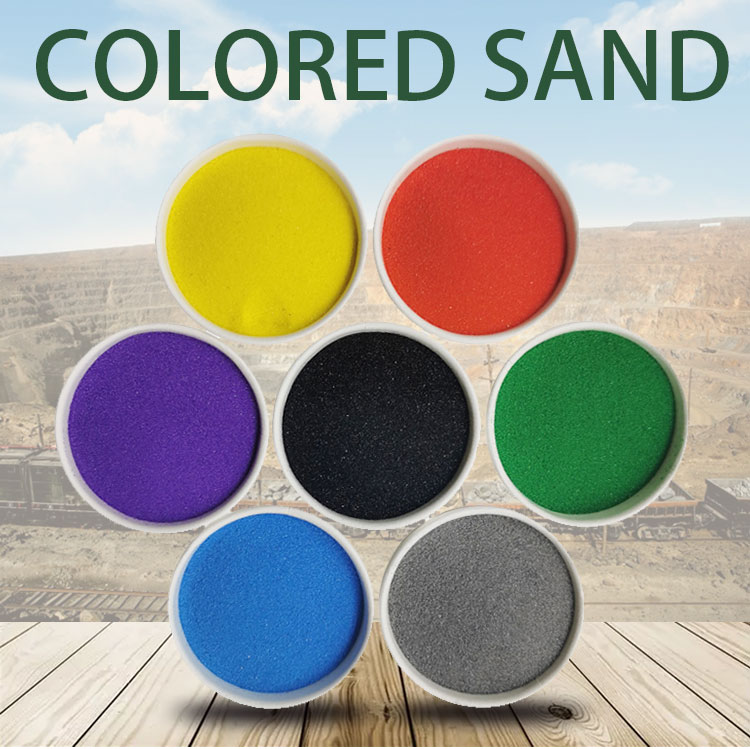
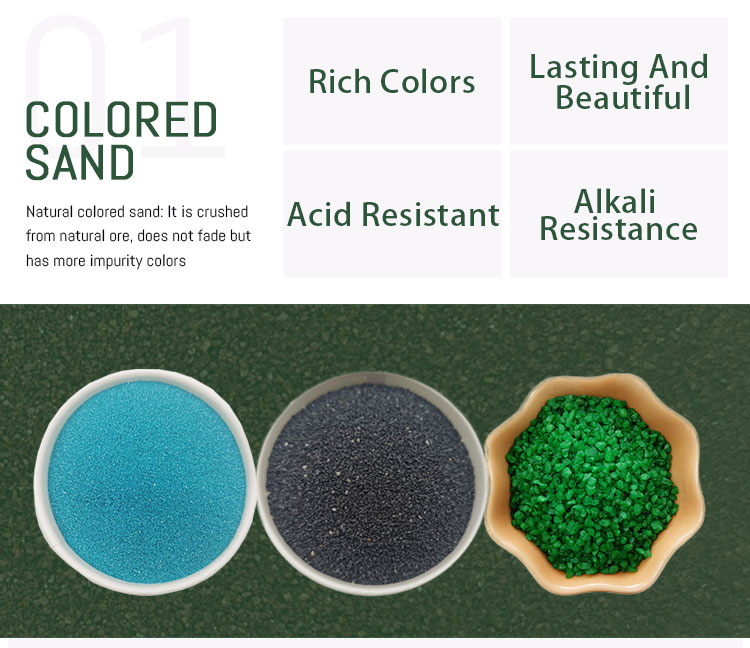
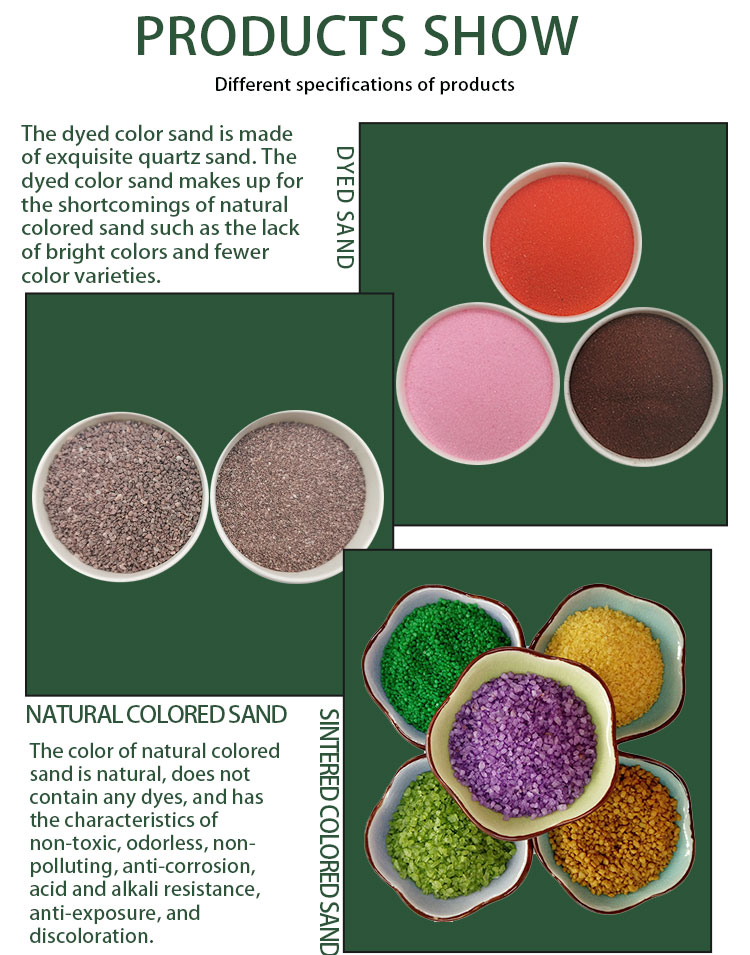
Colored sand is divided into natural colored sand, sintered colored sand, and dyed colored sand. Its characteristics are: bright colors, acid and alkali resistance, UV resistance, and no fading.
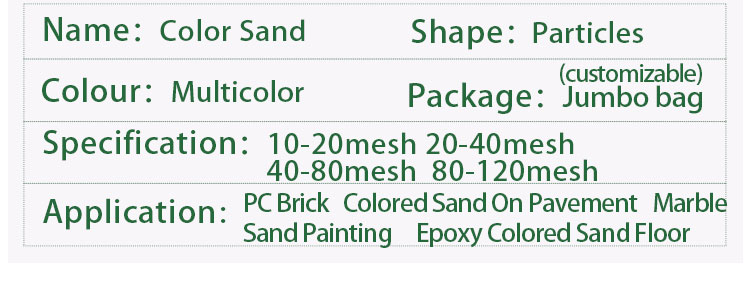
Type: natural color sand, colored sand.
size: 10-20.20-40.40-80.80-120.120-180.200mesh.
Write your message here and send it to us