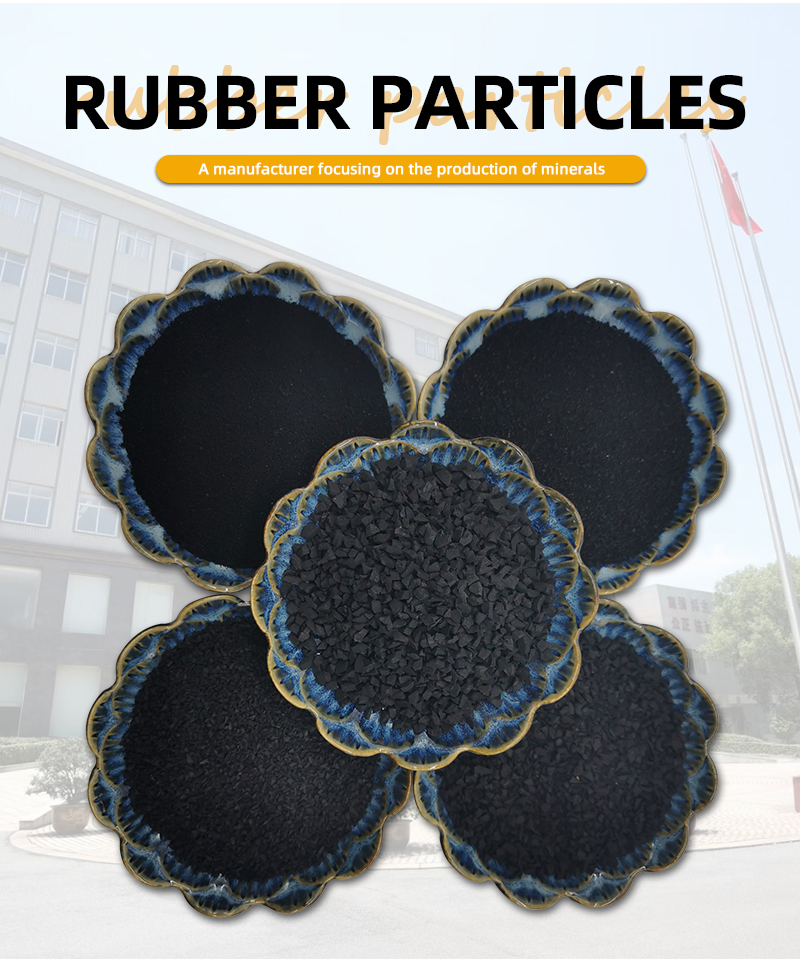
In road construction sector, rubber granules play a pivotal and irreplaceable role in modifying asphalt and enhancing comprehensive pavement performance. When evenly blended with bitumen, rubber granules not only improve the elasticity and deformation resistance of asphalt mixtures significantly but also enhance the mixtures’ ability to withstand repeated vehicle loads, thereby reducing the occurrence of rutting, cracking, and potholes under extreme temperature changes—whether it is the high-temperature baking in summer or the low-temperature freezing in winter. Such modified asphalt further exhibits superior fatigue resistance and water damage resistance, which can effectively extend the overall service life of road surfaces by 30% to 50% compared with traditional asphalt pavements. Recent large-scale trials in rural road sealing projects in multiple regions have demonstrated that incorporating rubber granules as aggregate substitutes not only reduces the consumption of natural aggregates but also effectively lowers maintenance needs and eliminates dust emissions, bringing practical and tangible benefits to local residents’ travel and daily life. The preparation of rubber asphalt requires precise control of mixing temperature, mixing time, and other key conditions to ensure the uniform dispersion of rubber granules in the bitumen matrix, thereby maximizing their performance-enhancing effects and avoiding local agglomeration that may affect pavement quality.
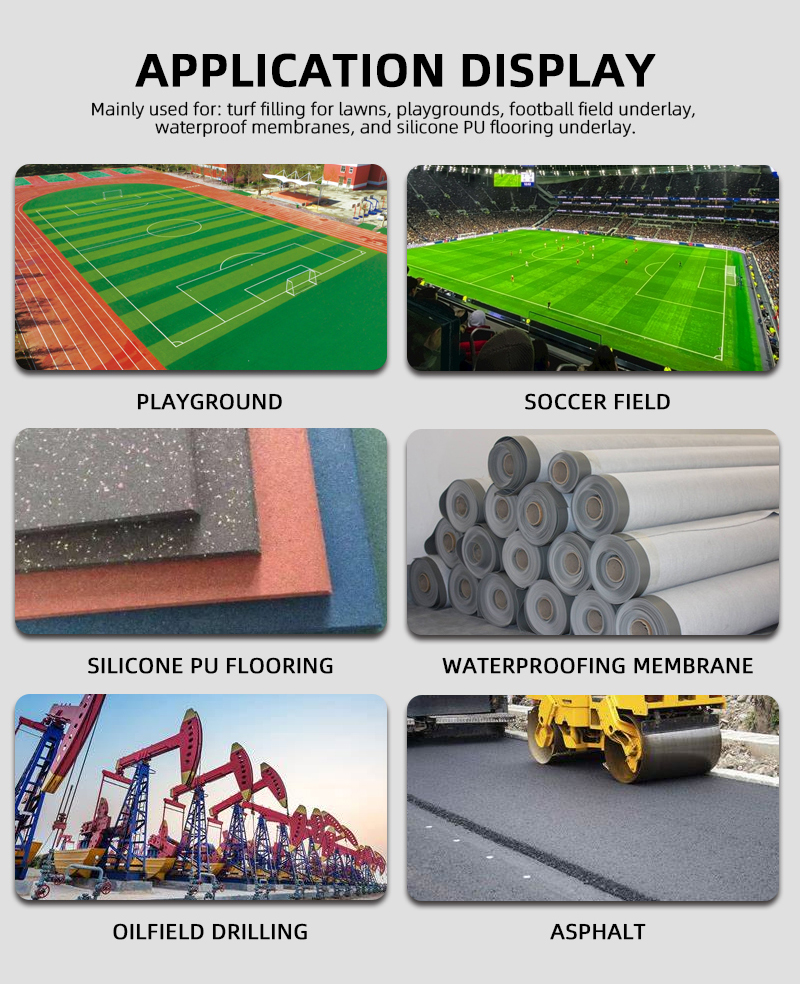
Sports and recreation facilities represent another major and fast-growing application area for rubber granules. As a core infill material for artificial grass, rubber granules fill the gaps between artificial grass fibers, providing soft, shock-absorbent, and anti-slip playing surfaces. This not only improves the safety of athletes during sports—effectively reducing the risk of falls and injuries—but also enhances the overall playing experience by simulating the feel of natural grass. Colored rubber granules, which are processed by adding environmentally friendly pigments during production and available in various vivid hues like green, red, blue, and yellow, are widely used in the construction of running tracks, football fields, tennis courts, and children’s sports grounds. These colored rubber granules not only meet the aesthetic and functional partitioning requirements of sports venues but also possess excellent properties such as wear resistance, UV protection, flame retardancy, and weather resistance, ensuring that the color and performance of the venue surface remain stable for a long time. EPDM rubber granules, a specific type of high-performance synthetic rubber granules, are particularly favored in professional sports facilities due to their outstanding oxidation resistance, ozone resistance, and low-temperature flexibility. Even under harsh environmental conditions such as strong ultraviolet radiation, heavy rainfall, and large temperature differences, EPDM rubber granules can maintain their structural integrity and performance stability, ensuring the long-term durability of sports facilities.


Production technologies of rubber granules continue to innovate and evolve, with physical crushing and low-temperature freezing crushing being the mainstream methods in the industry. Physical crushing technology, which typically includes processes such as tire shredding, steel wire separation, and granulation, is widely used due to its mature process and low production cost. However, it may cause partial aging of rubber due to the friction heat generated during crushing. In contrast, low-temperature freezing crushing technology uses liquid nitrogen to quickly cool waste rubber to a brittle state, then crushes it into granules. This method minimizes rubber aging during processing, producing granules with regular shapes, uniform particle sizes, and rough surfaces that can bond more firmly with other materials. After the initial crushing, subsequent grading and screening processes, which use multi-layer sieves of different meshes, classify rubber granules into various size ranges to precisely adapt to diverse application needs—for example, fine rubber granules with particle sizes below 1mm are suitable for asphalt modification, medium-sized granules of 1-3mm are used for artificial grass infill, and coarse granules above 3mm are applied for road base filling and shock absorption layers. In addition, chemical modification technologies such as surface activation and grafting modification further enhance the compatibility and bonding strength between rubber granules and bitumen, polymer materials, and other substrates, optimizing the overall performance of composite materials and expanding the application boundaries of rubber granules.

The global rubber granules market is experiencing steady and sustained growth, driven by the increasing global infrastructure construction investment, the continuous expansion of sports and recreation facility construction, and the growing emphasis on waste tyre recycling. North America and Europe remain the dominant markets for rubber granules, thanks to their mature waste recycling systems, strict environmental regulations, and high demand for high-quality sports facilities. In these regions, the application of rubber granules in road construction and professional sports venues is highly standardized. Meanwhile, the Asia-Pacific region shows strong and rapid growth momentum, fueled by the accelerating urbanization process, large-scale road network construction, and the rising popularity of sports activities in emerging economies such as China, India, and Southeast Asian countries. Major market players in the global rubber granules industry are focusing on technological innovation to improve product quality and production efficiency, as well as capacity expansion to meet the growing market demand. Industry collaboration has also become a key trend—raw material suppliers, production enterprises, and downstream application companies are strengthening cooperation to optimize the supply chain, address the variability of waste tyre raw materials, and jointly promote the standardization and upgrading of the rubber granules industry.
Despite their widespread applications and significant market potential, rubber granules still face certain challenges and bottlenecks in the process of industrial development. One of the key challenges is odor control during processing and application. During the production of rubber granules, especially high-temperature processing processes, and when used in high-temperature environments such as summer road surfaces or enclosed sports venues, rubber granules may release volatile organic compounds, resulting in unpleasant odors that affect user experience. Another major challenge is the optimization of dosage in different mixtures. The optimal dosage of rubber granules varies significantly depending on the application scenario—for example, the dosage in asphalt modification is different from that in artificial grass infill, and excessive or insufficient dosage may seriously affect the performance of end products, such as reducing pavement strength or decreasing shock absorption effect. This requires ongoing in-depth research and a large number of experimental verifications to determine the precise optimal proportions for different application scenarios. Additionally, the establishment of unified and authoritative industry standards and testing methods remains an urgent task globally.